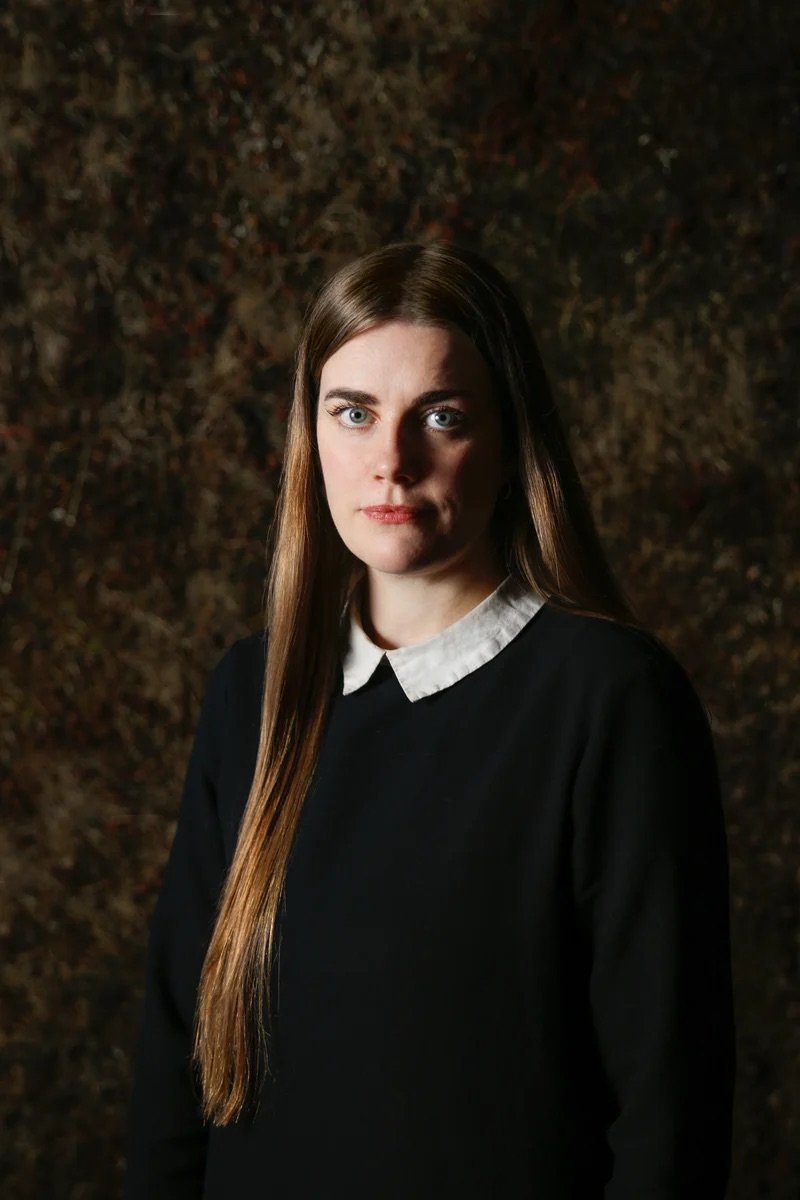
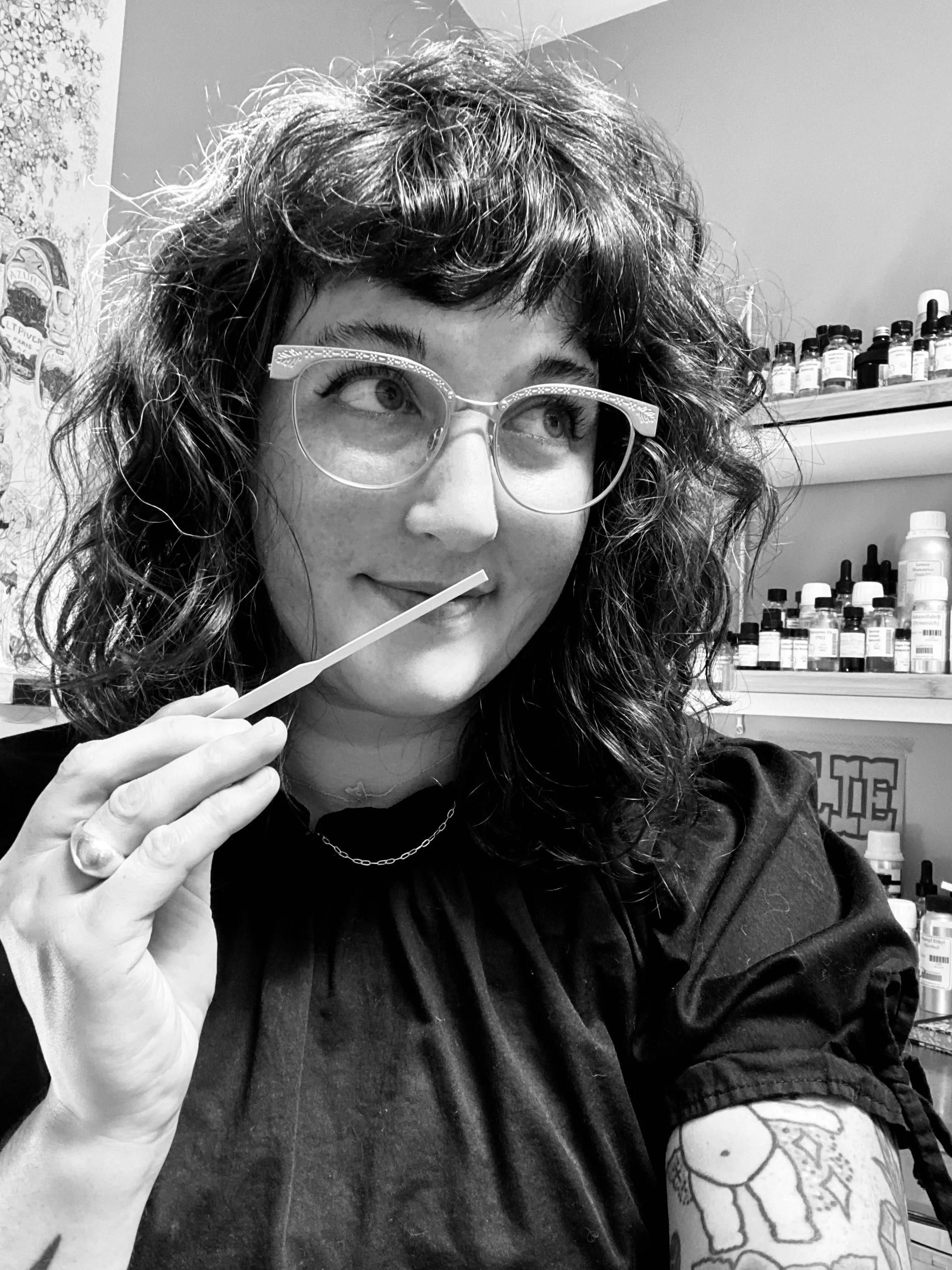
Alie Kiral, Founder & Perfumer of Pearfat Parfum
We are excited and proud to announce the first addition to the Fumerie family that began as a Fumerie Maker’s Residency featured artist: Pearfat Parfum! Alie’s work was truly our inspiration for the program in the first place, as we realized while first exploring Pearfat, there is far more out there we want to share with our beloved, discerning, and enthusiastic community than we could ever possibly carry. We also wanted to expose more folks to the growing DIY and self-taught movements that are happening all over the world currently (even our Residency participants spanned multiple countries), and to give a spotlight to the folks taking big swings in an industry that typically keeps up a lot of walls, and strictly perpetuates norms. Though we had to take a break from our Residency Program to focus on other projects (such as Ponte Etereo, and local collaborations), Pearfat has stuck in our mind and stayed on our radar until we finally said, “You know what? It’s time to bring them to Fumerie!” Please enjoy below an interview with Alie Kiral, Founder & Perfumer of Pearfat, and Tracy Tsefalas, Founder & Owner of Fumerie.
Tracy Tsefalas • Your approach to perfumery is less classic and more cheeky, nostalgic. There is a freedom and levity to this while also requiring technical skills. What was your path in learning the skills while still maintaining your playfulness and curiosity?
Alie Kiral • Being largely self-taught allows for me to utilize ideas that being classically trained may not. I have really out-there concepts I work with from time to time, but I’ve never had anyone in my ear telling me that these unconventional smells won’t work in perfume. I’ve been able to trust my own creative instincts, but also greatly benefit from having mentors and teachers who keep my process in check. I take understanding perfumery on a technical level very seriously, while never taking myself or my ideas too seriously at all. I am always deeply researching before working with a new material or trying a new accord in a formula. I strive for harmony between my beginner’s mind and my playful ideas, and the academic rigor that perfumery requires.
T • What have been some of your greatest challenges in bringing your fragrances to market and sharing your creations with the public?
A • Since I did not set out to create a brand, I did not start with ideas that were scalable. The biggest challenge has been maintaining my brand’s DIY identity and handmade feel while also striving for a polished, sophisticated end product. I began creating perfume as a hobbyist, and things grew from there - for the first few years of Pearfat, every dollar I made from my perfumes went straight back into streamlining and improving my processes in order to share with a wider audience. This is difficult to do on your own without experience running a business, so there’s been much trial and error, lots of mistakes, and certainly some carpal tunnel from hand-punching every label. Looking back at 5 years of Pearfat, I’m so floored and so proud that I’ve gotten where I am now and am excited to continue to fine-tune the brand. I’m so touched that there are still people shopping with me that bought my early leaky samples with handwritten labels, and I hope they know they’re a huge part of my story and the growth of the brand.
T • The presentation of your bottles are playful and minimal. You print the labels by hand and have chosen to forego lids. Was this a budgetary decision or a conscious attention to shift focus towards the fragrances themselves?
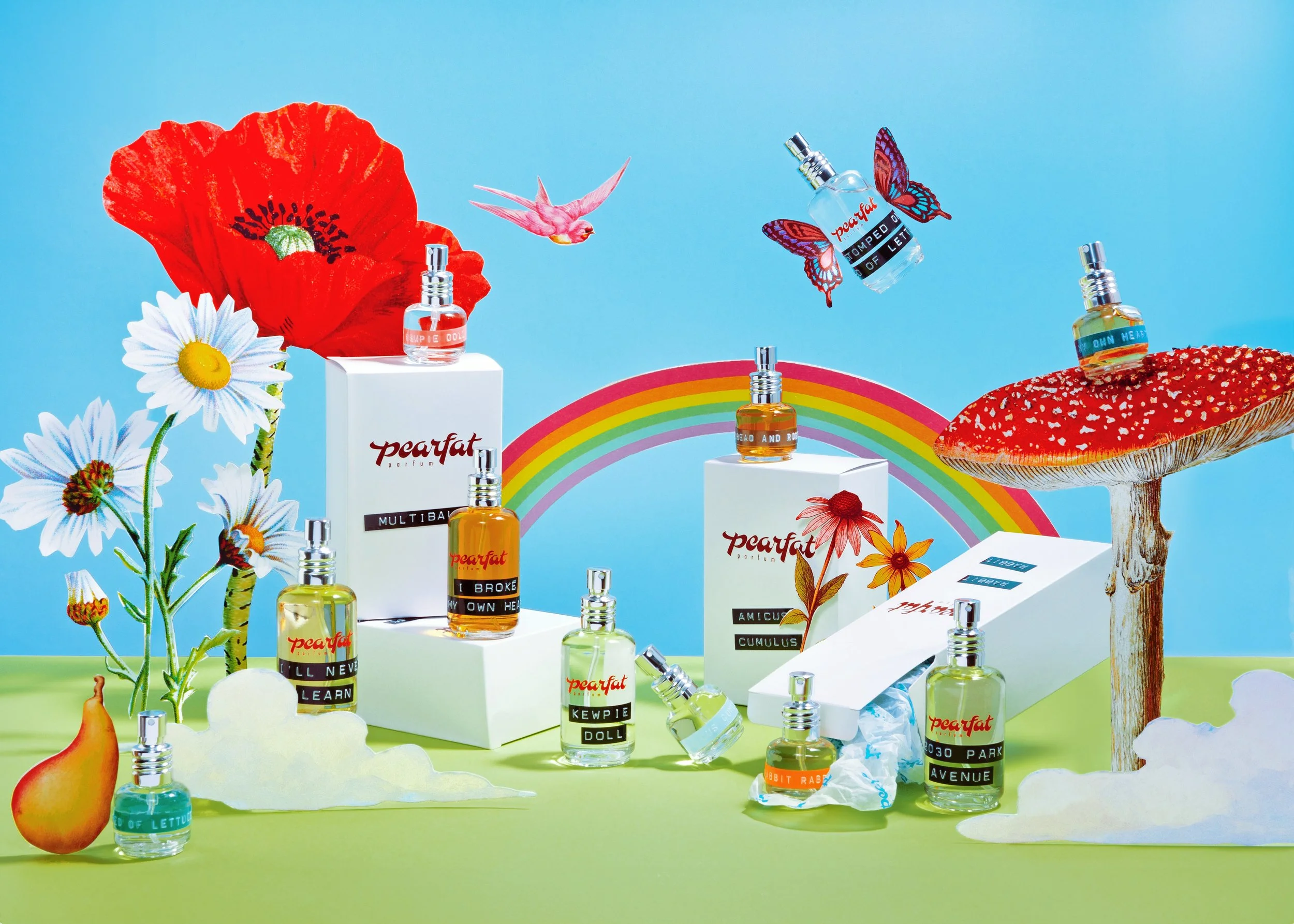
A • Certainly at the beginning of Pearfat, some of these choices were budgetary. I have no investors and haven’t taken in any money aside from the sales of my perfume - this is a true “from the ground up” operation. As things have grown and changed, I’ve decided to keep this minimal look as it has become a bit of a hallmark of Pearfat’s visual language. I deal so much in memory and nostalgia, I like the idea of the bottles being a bit of a blank page so that the wearer is able to insert themselves into the narrative of the perfume without too much power of suggestion. The evolution of my bottles and packaging continues with more growth and time, but I do always hope to maintain some of this minimalist, DIY vibe since it is very much the story of Pearfat.
T • A few years back, you participated in (and even gave us some feedback on developing our ideas around) the Maker’s Residency Program at Fumerie. We were thrilled to have you as our second resident artist, and you really helped to kick things off. In what other ways did you intentionally build your audience in the early days of Pearfat?
A • In the early days of Pearfat, I looked for any and every opportunity to share my work. I grew a loyal base of customers through participating in art fairs, sent perfume to other perfumers I admired, and even had my perfumes in vending machines at one point! I’d take samples with me everywhere I went, leaving them at boutiques and passing them out like candy. I was absolutely honored to be included in the Maker’s Residency - it felt like such a validating turning point for the brand to be featured at a place like Fumerie. Having that under my belt opened more doors for me to be taken seriously in the wider perfume industry.
T • DIY and self-taught perfumers are currently entering the market at a rate much greater than I have ever seen in my over thirty years in the industry. To what do you attribute the growth and overall support for these works in this current climate?
A • The current political climate, the proliferation of AI art, and the flattening of culture due to these conservative dominant voices has many people hungry for interesting, creative perspectives. I think that perfumery is an accessible, emotional, and tangible way to express yourself and learn about others. While many forms of art are being co-opted and made more boring and bland, indie perfumery seems to be moving in the other direction. I think the connection to the body, culture, and self-expression make it compelling to anyone with a nose! It never ceases to amaze me how much people engage when you bring up smells, sensory memories, perfumes, etc. - we crave reflection on these things as humans and DIY perfume is the place where this is happening most.
T • Are your creative inspirations always based on a personal experience?
A • They’re all personal to me, but not always a real, lived experience. The core collection of Pearfat fragrances are primarily rooted in memory and my own life. But, I also love to create fantasy worlds or work inspired by other art that I admire and that calls out for sensory elements. Be Very Afraid, which is an ode to body horror films and the creepy crawly feeling you get from static on a television screen, is an example of this. Charismatic Megaflora is my interpretation of a flower from another planet. All of these things are resonant with me, but not always rooted in reality.
T • Congratulations are in order for the growth and success of Pearfat, and yourself as an artist and entrepreneur, Alie! What has it been like adapting to the increased demand for your product? Are you still working solo, or have you brought in others to help?
A • Thank you! It means the world. Adapting to my success has been a journey! I am still largely working solo, but am so grateful to have a supportive partner and family and friends who step in to help me. My mother punches nearly all of the labels on my bottles now, and Keegan, my husband, is almost always with me for in-person events. I’ve also started working with a compounding contractor for some of my perfumes to scale, and work with a copywriter, photographers, and artists to keep things fresh. In due time, I will likely need an official employee, but I actually really love being in control of the many elements of Pearfat and really value the hands-on nature of my brand, even though it usually means long hours and no days off.
T • You mention that punk rock and zine culture are a big part of your brand inspiration. How do you see the greater sphere of influence commonly referred to as “counter-culture” impacting the medium of fragrance as more folks gain access to the resources needed to make fragrant art?
A • DIY perfume is punk rock! Perfume is often seen as this expensive, European, fancy, untouchable thing, when the truth is, everyone everywhere has an olfactory story to tell. I am proud to stomp on tradition and open the door for other perfumers who may not see themselves represented in the legacy brands and mainstream perfumery culture. Being self-taught, doing things your own way, and telling new stories is always going to be ‘counter culture’ and I love seeing more creators and perfumers embracing this, especially in this rather conservative era.
T • What was the experience of building a grassroots brand like? Do you feel there are particular challenges and rewards you found surprising in the unavoidable parasocial relationships folks build with brands they primarily engage with through social media?
A • Because the work I make with Pearfat is so personal, there is definitely a level of familiarity with ME, Alie, and my life that has been interesting to navigate. Mostly, this is amazing - I receive so many messages from people who love my perfumes, who are wearing them for comfort, for gender affirmation, for their weddings, vacations - I absolutely love to get these messages and feel so honored to be a part of people’s lives in this small way. The biggest difficulty or drawback with this has been maintaining my personal connection with my customer base while also keeping myself separate from the brand at some level. It can be hard to turn my Pearfat brain off and turn my non-perfumer brain on. Balancing this boundary is a challenge, but one that I am grateful for.
T • What comes next for Pearfat?
A • I hope to continue to grow not only as a creator of perfumes, but as a community leader in the fragrance world. I want to be an entry point for more interesting perfumers. I love teaching others and sharing my knowledge, so I hope to continue to organize workshops and events that bring people together to smell and learn, and be creative. Someday, I’d love to have a perfumery library filled with materials and resources where anyone can come create and experiment. In the near future, I’d like to scent a film, so filmmakers get in touch!
Explore Pearfat here
For those curious, we do plan to reestablish our Residency Program at some point in the future, and still accept applications, which you can find here